Showing posts with label wallpaper. Show all posts

Wednesday, June 28, 2017

140. Jeff Beck - Beck-Ola


 Flickr Download DeviantArt


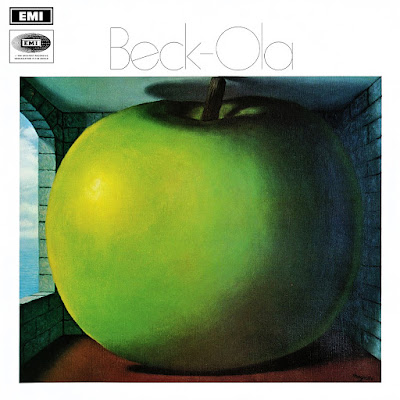
The cover art design for this album is the 1958 painting The Listening Room by the Belgian surrealist artist René Magritte. It features an
overblown green apple  large enough to fit a room from floor to ceiling.  One can also say that the room is small enough for an ordinary
green apple to fit it.  The topic of the size of the  apple or the room is the  subject that raises a question on the mind of the viewer.  In
either case,  the size of the apple  and the room  virtually leave no room for listening and,  again,  the question is  raised as to how the
title fits the painting or how the painting fits the title.

Jeff Beck's  use of the  1958 painting  for his album,  released in 1969,  perhaps finds  the answer.  It shows the apple inside a blue room
with a brick wall  that is opened by an arched window.  This is the later version of the painting.  The other,  from 1952,  originally shows
the apple inside a room with orange walls and a wooden floor.  

In my work above,  there was no such purpose or direction of finding space for 'the listening room.'  The process was purely random. The
finished work did find space outside of the apple  - and inside it.

But as soon as I thought that I had found room,  I realised that listening really doesn't require room or space,  for sound doesn't belong in
the category of space but of time.  One can't listen to this album sanely enough if there was another song or album playing with it at the
same time. One needs time to listen. To the music alone. 


Jeff Beck was right.


René Magritte was a surrealist with a dilemma for the beholder.
The beauty lies in the catharsis from being able to understand.


The original album cover art design is the 1958 version of The Listening Room by René Magritte.
Album produced by Mickie Most. EMI Columbia (UK), Epic (US) 1969. 


(A) All Shook Up - Spanish Boots - Girl from Mill Valley - Jailhouse Rock

(B) Plynth (Water Down the Drain) - The Hangman's Knee - Rice Pudding


"Rice Pudding" live from Lula Zepeliano on YouTube


Back to Gallery 5


Monday, June 12, 2017

139. The Pogues - Rum Sodomy & The Lash


 Flickr Download DeviantArt


The album's title is taken from a quotation attributed to Winston Churchill: "Don't talk to me about naval tradition. It's nothing but rum, sodomy, and the lash."
The title was suggested by drummer Andrew Ranken,  who said "it seemed to sum up life in our band".  The cover artwork is based on  The Raft of the Medusa,
a painting by  Théodore Géricault,  with the faces of  the men on the raft  painted by  the artist  replaced by those of the  members of the band  by illustrator
Peter Mennim. wikipedia

On the image above, the original album cover art design is superimposed over the painting The Raft of the Medusa.  The painting can be distinguished from its
different  tone on  the sides; darker at left  and lighter  at right.  One can  tell that the  album  cover  art was  lifted  not from the  centre of  the painting but
somewhat to the right. The combined images was converted to monochrome and the framing was added to make an 18" by 10" poster.


This is the painting The Raft of the Medussa by Théodore Géricault.


This is the original album cover art design.


No. 144, The Virgin All-Time Album Top 1000; No. 440, Rolling Stone, The 500 Greatest Albums of All Time


A third of Jeff Roesgen’s book documents the making of the album, with input from all of the Pogues except Shane [McGowan] and Cait [O'Riordan]. The other
two-thirds,  woven through the narrative,  place the band on board  The Medusa  as she makes her  fateful voyage from  France to Senegal.  It’s a  remarkably
effective technique.  I’d always  thought  of this record  as a product  of the post-punk  politics of 1980s  England and Ireland – but by placing  the band in the
early 19th century with a surrounding cast of soldiers, officers, navvies, as well as profoundly incompetent members of the ruling class, Roesgen highlights the
extraordinary achievement of the Pogues on this album. It’s a glorious celebration of the underdog, of the destitute and the downtrodden. 333sound.com


The Raft of the Medusa, painting by Théodore Géricault; replacements by Peter Mennim.
Album produced by Elvis Costello. Stiff (UK & Europe), MCA (US & Canada), 1985.


(A) The Sick Bed of Cúchulainn - The Old Main Drag - The Wild Cats of Kilkenny - I'm a Man You Don't Meet Every Day - A Pair of Brown Eyes - Sally MacLennane

(B) Dirty Old Town" - Jesse James - Navigator - Billy's Bones - The Gentleman Soldier - And the Band Played Waltzing Matilda


"Dirty Old Town" live from Moog Bass on YouTube


www.pogues.com

Monday, April 3, 2017

136. Yes - Relayer


Flickr Download DeviantArt


The album's sleeve was designed and illustrated by English artist Roger Dean, who had designed artwork for the band since 1971. Speaking about the cover in 2004, Dean said:
"I was playing with the  ideas of the ultimate castle,  the ultimate wall of a fortified city.  That was more of a  fantastical idea.  I was looking for the kinds of things like the
Knights Templar would have made or what you'd see in the current movie Lord of the Rings.  The curving,  swirling cantilevers right into space."  The images depicted in many
of Dean's album covers set an  otherworldly tone and are an  identifiable part of the  band's visual style.  For Relayer,  the warriors on horseback  reflect the  lyrical themes of
war present in "The Gates of Delirium". wikipedia


My tweak of the original album cover art design is simply the whole of the  front side of the gatefold that was
extended on the sides  by mirroring part of the original image  (left)  and by repeatedly  adding a portion of it
(right).  The album  title was  covered  and the  band's name  was used  to form a  cloud of smoke  from some
faraway fire, a sight which I think,  is not totally incompatible with a parade of horse-riding warriors treading
across an eerie and craggy landscape.

The mirroring  at left produced  what might look  like a starfish  misplaced in the arid terrain,  or some slimy
creature  encircling  a pointed crystal dome  in which sits an icon of  some alien idol,  but on the gatefold this
part of the image is actually the tail of a snake encircling a rock.


Cover art design and illustration by Roger Dean, album produced by Eddy Offord. Atlantic 1974. 


Rarely have a band and an artist been so closely associated through the years as Yes and Roger Dean. As of 1991, the prolific artist has drawn or painted eleven of the group's
album covers, from Fragile to Union. He's also designed covers for such Yes offshoots as Asia, Steve Howe's solo projects and Anderson, Bruford, Wakeman and Howe.

Dean thinks he knows why Relayer is singled out among his efforts for Yes:  "If I had to describe my skills," he says, "they started out with me being a designer and draftsman,
and Relayer  is the peak of those two skills.  "It took him about 300 hours  to render the artwork,  which was actually quite small  -  only an inch larger  than the wraparound
jacket  for the LP.

Curiously,  Dean had not heard  Relayer when he began work on the cover.  In fact,  Yes's Jon Anderson  came up with the title after seeing Dean's drawing.  "I never paint the
music," says Dean.  "I'm very skeptical of people who say they do.  It's very rare for the  members of Yes to sit down and say,  'This is the flavor of the music.  Do you think you
can get a bit more into the picture?' It doesn't work that way." www.superseventies.com


(A) The Gates of Delirium

(B) Sound Chaser - To Be Over


Sunday, March 26, 2017

135. Beastie Boys - Hello Nasty


Flickr Download DeviantArt


The title for the  album was allegedly  inspired by the receptionist of their NY based publicity firm  Nasty Little Man
who would answer the phone with the greeting "Hello Nasty".

The art cover depicts all three members (Horovitz, Yauch and Diamond from left to right) wrapped in an aluminium
sardine tin and getting baked in the sun. The band makes a reference to this in the song "Body Movin'," in which the
lyrics goes, "MCA, where have you been? Packed like sardines in a tin." wikipedia


Here's the original album cover art design.

No. 732, The Virgin All-Time Album Top 1000


Cover design by Bill McMullen, art direction by Cey Adams,
photography by Michael Lavine, album produced by Beastie Boys and
Mario Caldato, Jr. Capitol 1998.


Hello Nasty received mostly positive reviews upon release.  Caroline Sullivan,  writing for The Guardian,  named the
album the "Pop CD of the Week"  and stated that it  "fills a gap created by the current profusion of serious rock bands
like Radiohead;  elbowing its way up front, [and letting] rip with adolescent vigour."  She went on to summarize the
record as "the perfect party soundtrack by the perfect party band."

Although AllMusic's  Stephen Thomas Erlewine  felt that the album's ending was  "a little anticlimactic",  he also saw
Hello Nasty  as a progressive  step forward from the group's  1992 LP  Check Your Head,  and praised the input of the
group's  new  recruit,  Mixmaster  Mike;  "Hiring DJ  Mixmaster  Mike  turned  out  to be a  masterstroke;  he and the
Beasties created a sound that strongly recalls the spare electronic funk of the early '80s, but spiked with the samples
and post-modern absurdist wit that have become their trademarks." wikipedia

www.billmcmullen.com


(A) Super Disco Breakin' - The Move - Remote Control - Song For the Man - Just a Test - Body Movin'

(B) Intergalactic - Sneakin' Out the Hospital - Putting Shame in Your Game - Flowin' Prose - And Me - Three MC's and One DJ

(C) The Grasshopper Unit (Keep Movin') - Song For Junior - I Don't Know - The Negotiation Limerick File - Electrify

(D) Picture This - Unite - Dedication - Dr. Lee, PhD - Instant Death


"Intergalactic" live from BeastieBoysVEVO on YouTube.


Saturday, March 4, 2017

134. Smashing Pumpkins - Mellon Collie & The Infinite Sadness


Flickr Download DeviantArt


My tweak shares the same idea as John Craig's,  the illustrator who  designed the original album cover art.  His work was  destined to be a square;  mine a
rectangle,  but I ensured that  all the elements  of his work are in mine.  The idea to  repeat the  image of  Saint Catherine  was to emphasize  the central
character at  center although  I would have  placed more of it and/or faded it  towards the sides.  But I liked the colors  so much and  I wanted to preserve
them. My most noticeable mistake might be that I didn't reduce the size of her/their left hand/s to match the other.  


Billy Corgan liked to be involved in the visual side of the  Smashing Pumpkins albums,  sending ideas and rough sketches to the artists via fax.  The original
plan for Mellon Collie’s cover was for a French photographer to take a shot of the band in Victorian garb on an appropriate set, but that plan was scrapped
at the last minute when the  photographer named  an outrageous price.  John Craig,  a commercial illustrator  and collage artist  who was already working
on the internal sleeve art, was offered a shot at creating some cheaper cover art.

The iconic image is a collage made of three sources: the background comes from a children’s encyclopedia;  the star from a whiskey ad; the woman’s torso
from Raphael’s painting ‘Saint Catherine Of Alexandria’; and her head from a completely different painting, Jean-Baptiste Greuze’s ‘The Souvenir’.
FasterLouder


Saint Catherine of Alexandria by Raphael, c. 1507 from wikipedia

The Souvenir by Jean-Baptiste Greuze, 1787-1789 from wikimedia commons


The selection of the  collage elements was  something of a collaboration between Corgan and Craig,
who dug through his morgue in  search of imagery that  might suit the  musician’s vision.  Once they
settled on a few things, Craig got to work and assembled the woman on the star.

The image is deceptively simple,  as if the artist simply cut out a  picture of a woman and plopped it
on top of a star. In fact, the woman is composed of figures from two separate paintings manipulated
via photocopier  until their sizes  and shapes  fit together  perfectly.  The head  was sourced from an
18th  century  painting by  Jean-Baptiste  Greuze  entitled  “The Souvenir (Fidelity).”  Her  body was
borrowed from Raphael’s “St. Catherine of Alexandria.”

Both are stunning images on their own,  but together, they captured what Craig was after: “With the
Greuze,  there was something  very dreamy or ecstatic about  her expression that certainly wasn’t in
the Raphael painting.  And then [there’s]   the flow and color of the Raphael dress,  just the way it’s
rippling and almost traveling. I guess it’s those primary colors too.” Diffuser


This is the original album cover art design.


No. 76, The Virgin All-Time Album Top 1000


Cover art design by John Craig, art direction by Frank Olinsky.
Album produced by Alan Moulder, Billy Corgan & Flood. Virgin 1995.


Mellon Collie and the Infinite Sadness was released on October 24, 1995.  The following week, it debuted at number one on the Billboard 200, an unusual
feat for a double-disc album that cost over US$20. The album was certified diamond by the Recording Industry Association of America.

Christopher John Farley of Time  called the album  "the group's most ambitious  and accomplished work yet".  Farley wrote,  "One gets the feeling that the
band [...]  charged ahead on gut instincts; the sheer scope of the album (28 songs) didn't allow for second-guessing or contrivance."  Time selected Mellon
Collie and the Infinite Sadness as the best album of the year in its year-end "Best of 1995" list. Entertainment Weekly gave the album an A rating; reviewer
David  Browne  praised the group's  ambition  and wrote,  "Mellon  Collie  and the  Infinite Sadness  is more than  just the  work of a  tortured,  finicky pop
obsessive.  Corgan presents himself  as one of the last true believers:  someone for whom  spewing out this much music results  in some sort of high art for
the ages." IGN gave the album a score of 9.5 out of 10 and said,  "As the band's magnum opus it single-handedly changed the face of Alternative Rock. The
Music Box gave it all five stars and said, "Indeed, for all its melodramatic self-indulgence,  Mellon Collie is one of the best double albums of new material
to be released by anyone in a long time."


Rolling  Stone  gave the album three  out of  five stars.  Reviewer  Jim DeRogatis  praised the album as  "one of the rare  epic rock  releases  whose bulk is
justified in the grooves".  DeRogatis contended that while Mellon Collie "may even match  The Wall in its sonic accomplishments",  Corgan's lyrics lacked in
comparison.  Mojo reviewer Ben Edmunds also praised the music while  criticizing Corgan's lyrics.  In his Consumer Guide,  Robert Christgau picked out one
song from the album, "1979", as a "choice cut."

Mellon Collie and the Infinite Sadness  earned The Smashing Pumpkins  nominations in seven categories  at the 1997 Grammy Awards,  the second-highest
number of nominations that year. wikipedia


(A) Mellon Collie and the Infinite Sadness - Tonight, Tonight - Thirty-Three - In the Arms of Sleep - Take Me Down

(B) Jellybelly - Bodies - To Forgive - Here is No Why - Porcelina of the Vast Oceans

(C) Bullet with Butterfly Wings - Thru the Eyes of Ruby - Muzzle - Galapogos - Tales of a Scorched Earth

(D) 1979 - Beautiful - Cupid De Locke - By Starlight - We Only Come Out at Night

(E) Where Boys Fear to Tread - Zero - An Ode to No One - Love - X.Y.U.

(F) Stumbeline - Lily (My One and Only) - Tonight (Reprise) - Farewell and Goodnight - Infinite Sadness

Friday, January 27, 2017

132. Kate Bush - The Sensual World


Flickr Download DeviantArt


This work is pure  creativity without explanations.  I couldn't fully describe it,  what comes to mind first is the
amount of experimentation that went with the work, but a great album cover really makes for a great tweak.
I am aware  that any  attempt  to analyze  the work  might not come  without an  analysis  of my own psyche.

It would be introspection.  And much  in the same way  as the rose seems  to float  in the air, I would bare my
soul and speak my mind out and tell myself, "I can't explain it!"


The rose will not float in the air until you let go of it. This is the real world.


Photography by John Carder Bush. Album produced by Kate Bush.
EMI (all except US), Columbia (US) 1989.


What's always been remarkable about Kate Bush has been the ability to withdraw from the music world, escape
from the  machine,  and return  months  or years later with  something  rejuvenating,  original,  set apart from
chart-fodder  disposable pop.  Like  David Bowie in the 70s,  Bush in the 80s  has been one of the  true oddities,
exceptions to the rules. Always out of step, always unique.

And always,  as The Sensual World  implies,  provocative.  Bells ring  as you  enter her  'Sensual World',  bells of
celebration,  of sensual joy.  "The communication of music is very much like making love," she once said, so it's
entirely appropriate  that she should derive  her title track from  James Joyce's Ulysses and,  in particular, Molly
Bloom's thoughts on sex, sensuality and oysters at 2/6 per dozen.

"Because I couldn't  get permission to use a piece of Joyce  it gradually turned into the songs about Molly Bloom
the character  stepping  out  of the book,  into  the  real world  and  the  impressions  of sensuality,"  says Kate,
softly, almost childlike.  "Rather than being in this two dimensional world,  she's free, let loose to touch things,
feel the ground under her feet, the sunsets, just how incredibly sensual a world it is. 
Exploring The Sensual World, The Quietus


(A) The Sensual World - Love and Anger - The Fog - Reaching Out - Heads We're Dancing


Saturday, January 21, 2017

131. Chuck Berry - The Great Twenty-Eight


 Flickr Download DeviantArt


This album was released in 1982 but the songs are actually from the 50's and 60's. The original album
cover art,  indeed,  doesn't  look like  it was created in the 80's,  even with its  Harlow-like  typeface
(1930's) for the album title and block-type lettering for the name of the artist. The colours are basic;
all three primary colours, and the photo, a posterized black-and-white. 

The pose, of course, is classic Berry. 

It's a  coffee-inspired  tweak  I did  and one that  I would love  to see
hanging on the wall  of my favourite coffee shop  while I sip a cup of
the brew that I'm all too familiar with soft music to go.

No sweeteners required. This time, just Berry.  


No. 21, Rolling Stone, The 500 Greatest Albums of All Time; No. 51, Entertainment Weekly, 100 Greatest Albums Ever


Cover art design by Mike Metz. Album produced by Leonard Chess & Phil Chess. Chess 1982.


This is the place to start listening to  Chuck Berry.  The Great Twenty-Eight  was a two-LP,  single CD compilation that
emerged during  the early '80s.  It has proved  to be one of the  most enduring of all compilations  of Berry's work.  Up
until the  release  of this disc,  every attempt  at a compilation  had either  been too sketchy  (the  1964 Greatest Hits
album on Chess)  or too demanding for the casual listener (the three Golden Decade double-LP sets),  and this was the
first set to find a happy medium between convenience and thoroughness. 

Veteran listeners will love this CD  even if they learn little from it,  while neophytes will want to play it to death.  All
of the cuts come  from Berry's  first nine years in music,  including all  of the major singles as well as  relatively minor
hits such as "Come On"  (which was more significant  in the history of rock & roll in its  cover version performed by the
Rolling Stones as their debut release).  The sound is decent throughout (surprisingly, except for  "Come On," which has
some considerable  noise),  although it is  considerably  outclassed  by the most  recent round of  remasterings.  In the
decades since its release,  there have been more comprehensive  collections of Berry's work, but this is the best single
disc, if one can overlook the relatively lo-fi digital sound. Bruce Eder for AllMusic


(A) Maybellene - Thirty Days - You Can't Catch Me - Too Much Monkey Business - Browned-Eyed Handsome Man - Roll Over Beethoven - Havana Moon

(B) School Days - Rock and Roll Music - Oh Baby Doll - Reelin' and Rockin' - Sweet Little Sixteen - Johnny B. Goode - Around and Around

(C) Carol - Beautiful Delilah - Memphis - Sweet Little Rock and Roller - Little Queenie - Almost Grown - Back in the USA

(D) Let It Rock - Bye Bye Johnny - I'm Talking About You - Come On - Nadine - No Particular Place to Go - I Want to be Your Driver


"Johnny B. Goode" live with Bruce Springsteen from Johnny B. Goode on YouTube